

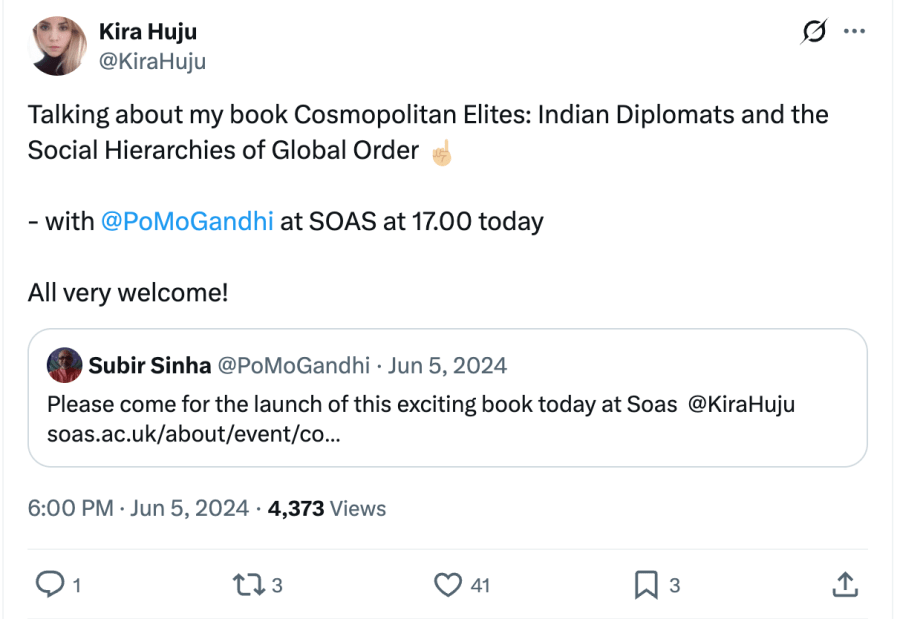
Dr. Kira Huju is a journalist with The Economist‘s working as their Asia correspondent. She is from Finland. Previously, she was a Lecturer in International Relations at Oxford University and a Fellow in International Relations at the London School of Economics and Political Science. She was temporarily assigned to work at the UK Foreign Office as an India Research Analyst. Kira Huju was a visiting fellow at the Jawaharlal Nehru University (JNU) in 2019. She is author of the book Cosmopolitan Elites: Indian Diplomats and the Social Hierarchies of Global Order that “won” the 2025 Best Book Award for Diplomatic Studies from the International Studies Association. India and South Asia Analysts Network (INSAAN) describe Kira Huju as “an India specialist in the Expert Working Group on Global Order convened by the European Council on Foreign Relations.” While she says her work is a critique of Hindutva, she conflates it with the Hindu identity and Hinduism itself. Her article “The cosmopolitan standard of civilization: a reflexive sociology of elite belonging among Indian diplomats” published in the European Journal of International Relations was funded by the Economic and Social Research Council UK (ESRC).
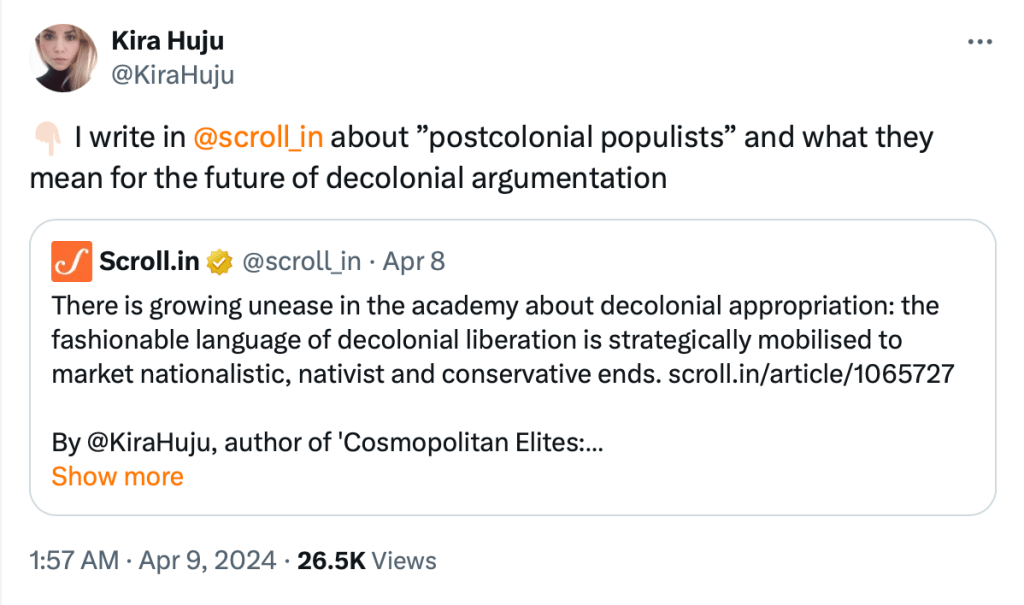
In 2024, Kira Huju penned an article for the University of Pennsylvania’s Centre for the Advanced Study of India (CASI), “Decolonizing Indian International Relations: Postcolonial Populists and Ethical Quandaries“, where she ranted against Indians for not conforming to the de-colonial framework set by the West and accused Hindus of de-colonial appropriation. In the piece, she feels offended when Hindus talk about decolonising from Islamic and Christian narratives, calling it “nationalistic, nativist, and conservative”. She perceives that the Indians’ “historical narratives of victimisation at the hands of the West are employed to dress up contemporary authoritarian politics as a project of de-colonial liberation.” Then she drags in Hindutva: ” In India, ‘de-colonial Hindutva’ marries the nativist politics of Hindutva with the formerly left-wing language of anti-imperialism. It invokes historical repertoires of resistance against the British Raj to sell the project of revanchist nationalism against imagined enemies – from “Westernised” dissident academics and journalists at home to “imperialist” human rights monitors abroad.” Kira Huju further accuses Hindus of Islamophobia for starting de-colonisation from the times of Islamic invasion and not with the arrival of the British. “Indian colonial subjugation is dated not to the arrival of the British East India Company in the mid-18th century, but the advent of the Mughal courts in the 16th century, allowing Hindutva historiography to subsume anti-Muslim politics under the banner of de-colonial nation building.” Speaking of de-colonial scholar, J. Sai Deepak, Kira Huju says, “For Deepak and fellow postcolonial populists arguing in this emerging tradition of thought, the indigene of Bharat is not just any Indian (or, as one might have expected, India’s indigenous Adivasi communities) but the Hindu, who despite uncontested majority status in Indian society, is read as oppressed by religious minorities.” Accusing Hindus of undermining India’s Constitution, she says, “Deepak explains the necessity of undermining India’s secular Constitution as a relic of colonialism and restoring the Hindu to majoritarian greatness. Hindu majoritarianism is sold to the reader as an act of indigenous emancipation.”
In 2022, Kira Huju penned an article “Saffronizing diplomacy: the Indian Foreign Service under Hindu nationalist rule ” in which she wrote on the saffronisation of the Indian Foreign Service (IFS) since 2014, called it Hindutva diplomacy, accusing Hindus of saffronising India’s westernised and liberal foreign policy for an imagined “India as a Hindu nation, both by reconstructing an imaginary past defined by Hindu unity and by refashioning political institutions to reflect majoritarian ideals.” Speaking of foreign diplomats, she says, “the once dominant Anglophone class of diplomats is to be replaced by a new Indian elite invested in Hinduism, the Hindi language and a narrower sense of nationalistic pride. ” Kira Huju takes offence to the fact that changing the character of the IFS from Anglophone, western and secularised to Hinduism, Hindi and nationalism: “the once dominant Anglophone class of diplomats is to be replaced by a new Indian elite invested in Hinduism, the Hindi language and a narrower sense of nationalistic pride” which “is likely to have consequences for the behaviour of a major rising power.” Citing ‘scholars’ of Indian foreign policy, Kira Huju says, “Modi’s purportedly transformative approach to foreign policy has failed to defy any basic tenets of India’s long-running foreign policy doctrines.”
Kira Huju says, while Nehru carefully crafted the as an “internationalist, globalist culture” while promoting the idea of India as a land of snake charmers, Modi in 2014 has challenged that idea of Nehru. She goes on to say that in the 70’s, India diplomats “consciously countered any foreign impressions of India as a Hindu rashtra, or Hindu nation.” Huju finds it offensive that Indian missions aboard celebrate and promote Hindu festivals like the Kumbh Mela, that Indian PM prefers to visit Hindu temples on his overseas visits and often gives Hindu artefacts like the Bhagwad Gita to visiting political counterparts. She says promoting Yoga and Ayurveda is ‘soft’ Hindutva which “marks a departure from a time when ambassadors would negotiate with Spanish dictionary-makers to combat impressions of India as a Hindu rashtra.“
In a round‑table discussion of her work,” India’s International Relations: Saffronising Foreign Policy “, Kira Huju stresses the need to distinguish Hinduism, as a diverse religious-philosophical tradition from Hindutva, a modern nationalist ideology but then goes to say that promotion of Yoga, Ayurveda and Hindu festivals abroad may seem as innocuous soft power but they are indeed Hindutva: ” Promotion of international yoga day or of Hindu festivals abroad may seem in many ways innocuous ‘soft power’ practices, to which those with secular Hindu worldviews would hardly have any objections. Yet these are Hindutva projects. “
In an interview with American far-left media, The Wire, Kira Huju says since 2014 Indian politicians are managing diversity by suppressing it, finding a new language of unity, find a different internal other, find a different way of constructing the polity”.
Hira Kuju X: @KiraHuju





 STOP HINDU HATE ADVOCACY NETWORK