
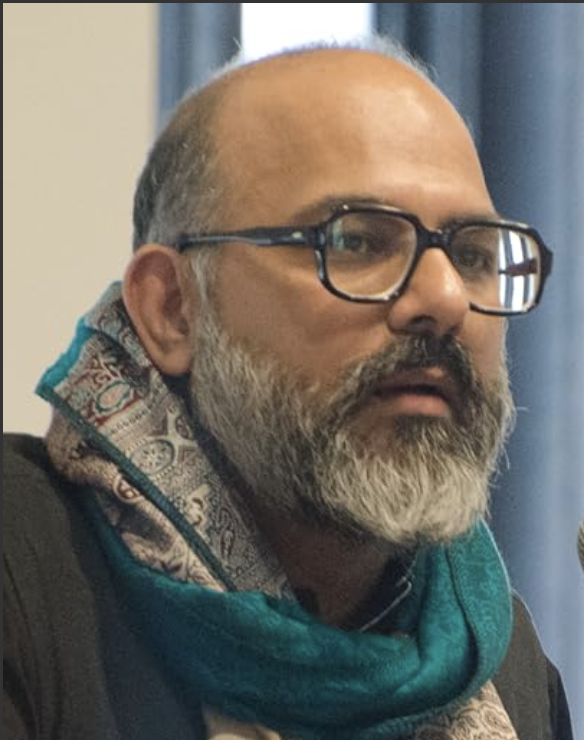
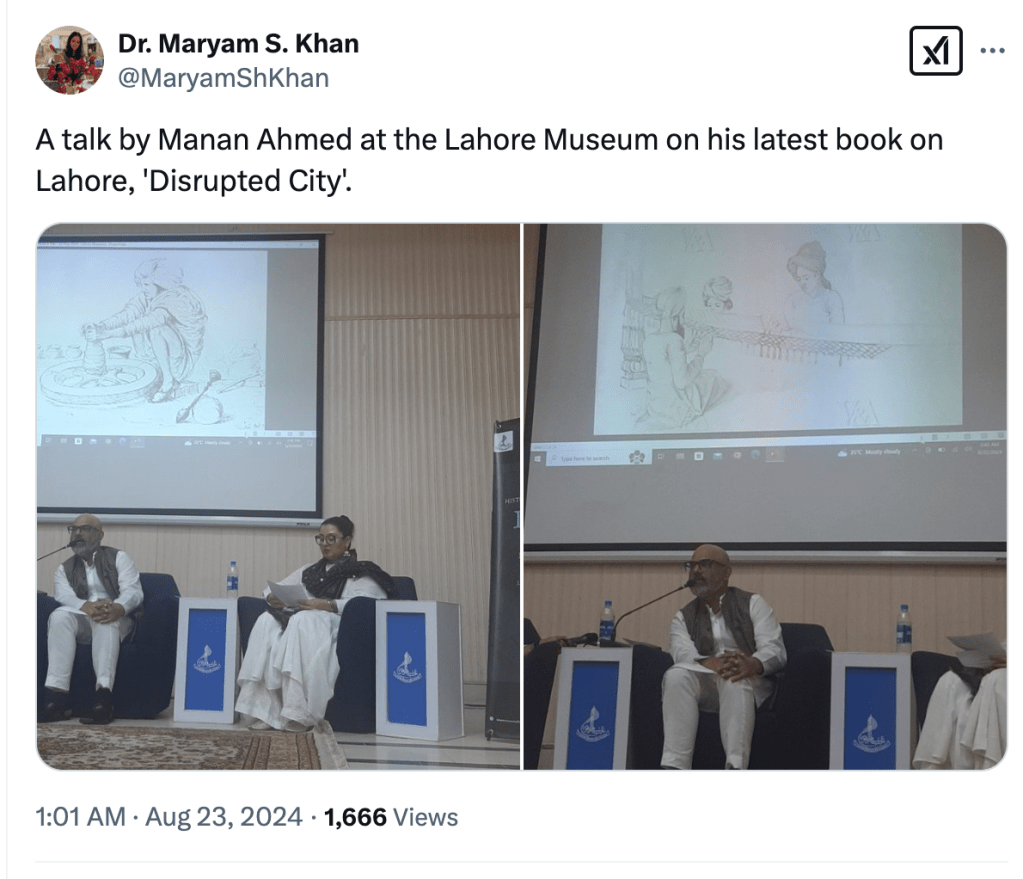
Pakistani-born Manan Ahmed Asif is an Associate Professor at the Department of History at Columbia University. As per Columbia University’s website, he is “a member of Columbia’s Center for Study of Ethnicity and Race, Center for the Study of Muslim Societies, SOF/Heyman and Committee on Global Thought. He is a Senior Editor at Comparative Studies of South Asia, Africa and the Middle East. He is on the Editorial Board for the journals Philological Encounters, South Asian Studies, and Al-‘Usur Al-Wusta: The Journal of Middle East Medievalist.” Manan Ahmed has authored three books – A Book of Conquest: The Chachnama and Muslim Origins in South Asia, The Loss of Hindustan: The Invention of India and Disrupted City: Walking the Pathways of Memory and History in Lahore.
Manan Ahmed is a member of the South Asia Scholars Activists Collective (SASAC). The SASAC launched The Hindutva Harassment Field Manual which “offers educational and practical resources for the targets, allies, students, and employers of those subjected to Hindu Right assaults.” Manan Ahmed was supportive of Dismantling Global Hindutva Conference. He co-ordinates the Qalam Pakistan Initiative which had invited Hafsa Kanjwal known for her closeness to Pakistan ISI and is a Kashmiri separatist. Manan Ahmed has two on-going research projects “Decolonization, the Disciplines and the University” with grants from Mellon Foundation and “Muslims in India” funded by the Luce Foundation. Mellon Foundation and Henry Luce Foundation are both known to have links with America’s Central Intelligence Agency (CIA).
Manan Ahmed is a Board member at the American Institute of Pakistan Studies (AIPS). Audrey Truschke, known for Christian missionary links and hatred for Hindus, is also a member of AIPS. In 2013, Manan Ahmed worked closely with Moeed Yusuf, who became the National Security Advisor for the Government of Pakistan from 2021 – 2022.
Jewish group Canary Mission have a profile on him for this anti-semitism.
Ken Chitwood, a Lutheran theologian, pastor, and professor at the University of Bayreuth‘s Department of Religion, edited and produced a guide on Hindu nationalism for those “harassed” by Hindu nationalists. All members of the SASAC contributed to this guide, in which they describe Hindu nationalism as a “far-right political ideology of Hindu supremacy…Also known as Hindutva”. According to the guide Hindu nationalism/Hindutva’s core objective is to transform India, “a constitutionally secular state, into a Hindu Rashtra (nation) where some Indians will be more equal than others”.
Co-authoring with Rohit Chopra and Audrey Truschke, North America Has a Hindu Nationalist Problem, and Scholars are On the Frontlines of These Right-Wing Attacks for the Religion Dispatches Manan Ahmed defends the need for Hindutva Harassment Field Manual to document “assaults on academic freedom” by far right groups and individuals who promote the political ideology of Hindutva, or Hindu nationalism.” They further write “Hindu nationalists……imagine the Indian past as an era of Hindu glory that was destroyed by despotic Muslim conquerors.” On the issue of California textbook controversy, the authors equate White supremacy with Hindu nationalism, “White supremacists and Hindu supremacists share a desire to discriminate without consequences.”
In a Huffington Post article on Far-Right Hindu Nationalism Is Gaining Ground In The U.S., Manan Ahmed tries to gatekeep Hinduism by saying that Hindutva, a far-right political ideology, is not Hinduism, the faith. He said, “Hindu nationalists are morphing the religious, political and racial into one identity in order to advance a supremacist, majoritarian agenda.” During the Dismantling Global Hindutva conference, various speakers equated Hindutva with Hinduism and went so far as to declare Hinduism as dangerous to independence, equality and brotherhood and an enemy of democracy.
Manan Ahmed in How Hindu Nationalists Redefined Decolonization in India says that “the Hindutva idea of decolonisation is a colonial one” in which the British played the role of liberators while portraying foreign Muslim invaders as the real colonisers from 800 years of slavery. Ahmed says, “This colonial idea hinges on anti-Muslim sentiment, framing Islam and Muslims as outsiders to the subcontinent. This is precisely the politics of Hindutva and thus a smooth transference. Again, one can see how frequently colonial authors and scholarship are cited as ‘evidence’ of Muslim tyranny.”
In his book, The Loss of Hindustan: The Invention of India, Manan Ahmed uses Pakistani poet Allama Mohammed Iqbal’s Tarana-E-Hindi (Sare Jahan Se Acha Hindustan Humara) composed in 1905 that glorifies the land of undivided India to argue that India is home to all religions and does not belong to any particular faith. In an interview with Columbia News about his book, Manan Ahmed said “India, Pakistan and Bangladesh share a common political ancestry: They are all part of a region whose people understand themselves as Hindustani.” He describes Hindustani as one who lives in Hindustan – a home to all faiths. He argues that it was during the British rule that V. D. Savarkar “put forth the concept of Hindutva and an India where only natural-born Hindus could live and flourish.” And to make India a Hindu home-land the British unleashed great violence in the subcontinent ignoring the All India Muslim League’s violence on Hindus for a separate Islamic state of Pakistan.
In The Heavy History of Names: On Political Forgetting and Erasure in India, Manah Ahmed expresses concern over Hindus reclaiming the name Prayagraj from Allahabad. The city was renamed Allahabad by the Mughal King Akbar in 1583, which positions the Mughals as a colonising force in this context. The name Prayagraj is mentioned in the Rig Veda, “indicating that the sanctity of the confluence of rivers was recognized even during this early period.” This suggests that Prayagraj was the original name before Akbar changed it to Allahabad.
In the article “How Colonial Myths About the Arrival of Muslims in Sindh Still Divide the South Asian Mind” published by The Wire, Manan Ahmed argues that Muslims in India came not as Islamic invaders, but as settlers and blames the British for giving it a religious colour. He states, “We cannot be held hostage to British narratives about Muslim arrival in India as religion-inspired invaders from Arabia.”
Speaking at Ahmedabad University’s School of Arts and Sciences Manan Ahmed said, that India is a name given by the British and the original name of India is Hindustan used by Islamic invaders. He says that the European understanding of India as a Hindu nation replaced the previous “understanding of India as Hindustan, a home for all faiths.” He dismisses the Hindu Sindhu-Saraswati civilisation of India as the Hindutva ideology of an imagined past. In one article The Heavy History of Names: On Political Forgetting and Erasure in India, Manan Ahmed says since Partition the word Hindustan has become “a simple Hindi word for “India,” an articulation of Hindu chauvinism, or, more rarely, something associated with the bygone era of the Mughal polity—itself understood by the Hindu Indian as a demonstration of the imperial violence of foreigners.”
Readers should note that Manan Ahmed does not mention that Iqbal composed “Taarana-e-Mili” (Anthem of the Community) in 1910, an Islamic fundamentalist poem advocating for a separate Islamic state of Pakistan. In this poem, Iqbal reflects on the glory of the Islamic empire in India and emphasizes the unity of the Islamic Ummah, portraying India as their “homeland.” He asserts that Islam is the religion of the world and describes how it rid Arabia of polytheism and introducing Tawhid—the concept of monotheism. In a presidential address to the All India Muslim League in the 1930s, Iqbal stated, “India is a continent of human beings belonging to different languages and professing different religions. I, therefore, demand the formation of a consolidated Muslim state in the best interests of the Muslims of India and Islam.”
Manan Ahmed presents a view of Indian history centered on the “concept history of Hindustan,” arguing that the idea of India as a Hindu homeland stems from European colonial discourse and later influenced figures like Savarkar. Using the example of Tarikh-i-Firishta by Mohammed Qasim Firishta, Manan Ahmed tries to prove India was “Hindustan”, a land of all faiths and not just Hindus. While Ahmed emphasizes this pluralism, historical texts like Baburnama and Tarikh-i-Firishta also document the violence of Mughal rulers. For example, Firishta recounts the 1360 destruction of Nagarkhot, Punjab, where Firuz Shah Tughluq Firishta writes, “The Sultan broke the idols of Jwalamukhi, mixed their fragments with the flesh of cows, and hung them in nosebags round the necks of Brahamans, and that he sent the principal idol as a trophy to Medina.”
Manan Ahmed laments that while there are many books on ancient India anything along the lines of ancient Pakistan or ancient Bangladesh “seems to be incongruous“. He further argues that “India, Pakistan and Bangladesh are modern inventions that come into being in at one particular place…..so they all should be taken as ancient or none of them should be taken as ancient”.
In an interview with a Pakistani influencer on Decolonization and the loss of Hindustan, Manan Ahmed stated that there is nothing called India and that viewing India as the home of Hindus is a colonial construct. This narrative is misleading, as even the left-leaning “mythologist” Devdutt Pattanaik acknowledges that India is mentioned in the Rig Veda. Ahmed holds Veer Savarkar responsible for introducing the concept of India as a Hindu homeland. He cites Mohammed Iqbal, who wrote “Sare Jahan Se Acha Hindustan Hamara,” suggesting that it reflects the universality of India. In contrast, Savarkar’s notion of making India a Hindu homeland aligns with Hindutva or Hindu nationalism. Manan Ahmed references Islamic texts from the 11th and 12th centuries to argue against the idea that Hindus do not have a natural homeland, even though several Indian manuscripts including the Rig Veda dating back to 2000-1500 BC, Vishnu Puran mention that Bharat, as a nation of Hindus. Declaring Modi as a fascist Manan Ahmed expects resistance from anti-CAA protestors, farmers protestors that could give hope to people towards removing Modi from power.
In a talk with Emmanuel Kattan on “Is India becoming an Ethnic Democracy?“, Manan Ahmed claims that during Modi’s tenure as Chief Minister of Gujarat, the killing of innocent civilians, often portrayed as terrorists or Pakistani agents, became a routine form of violence. Furthermore, Ahmed points out that the violence against Muslims in India during 1947-48 started with Sardar Vallabhai Patel’s efforts to rebuild the Somnath temple, ignoring the All India Muslim League’s call for violence against Hindus during the 1946 Direct Action Day.
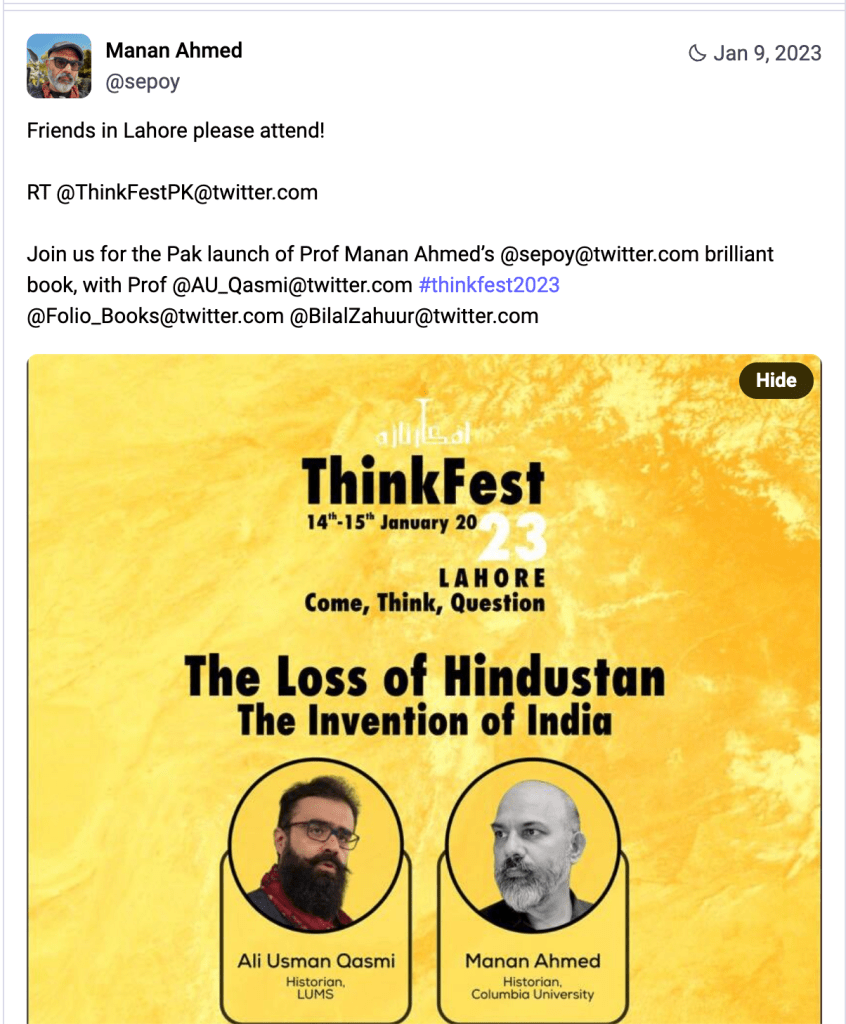
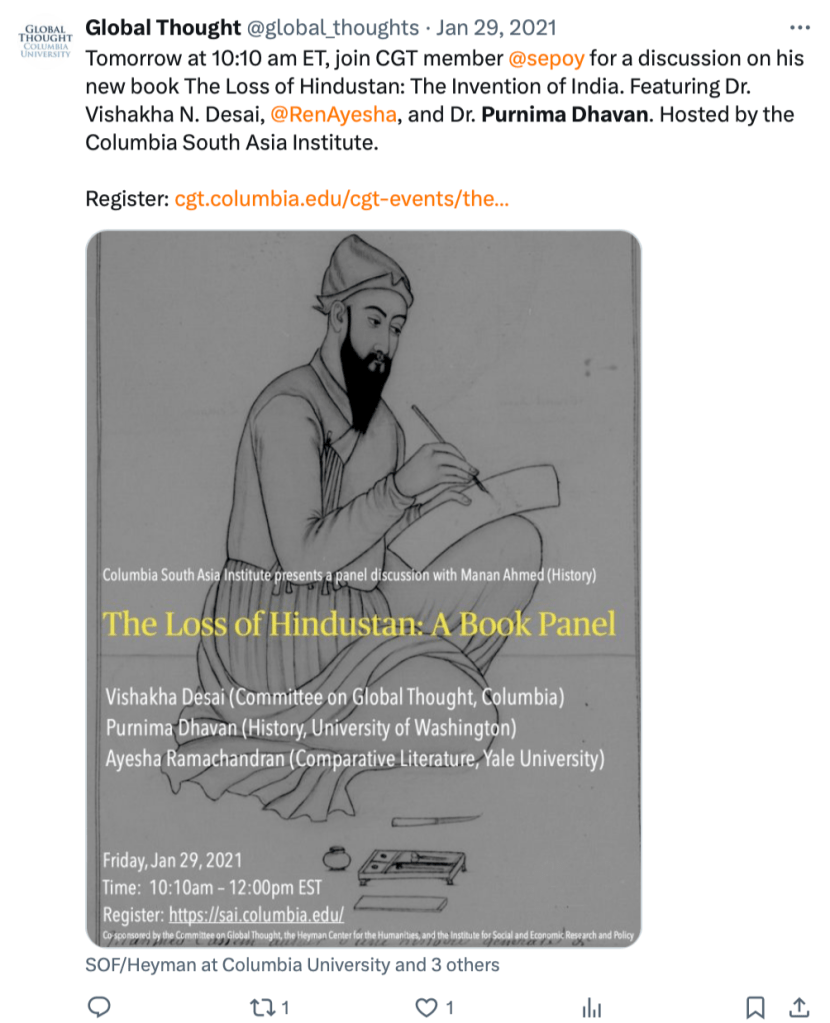
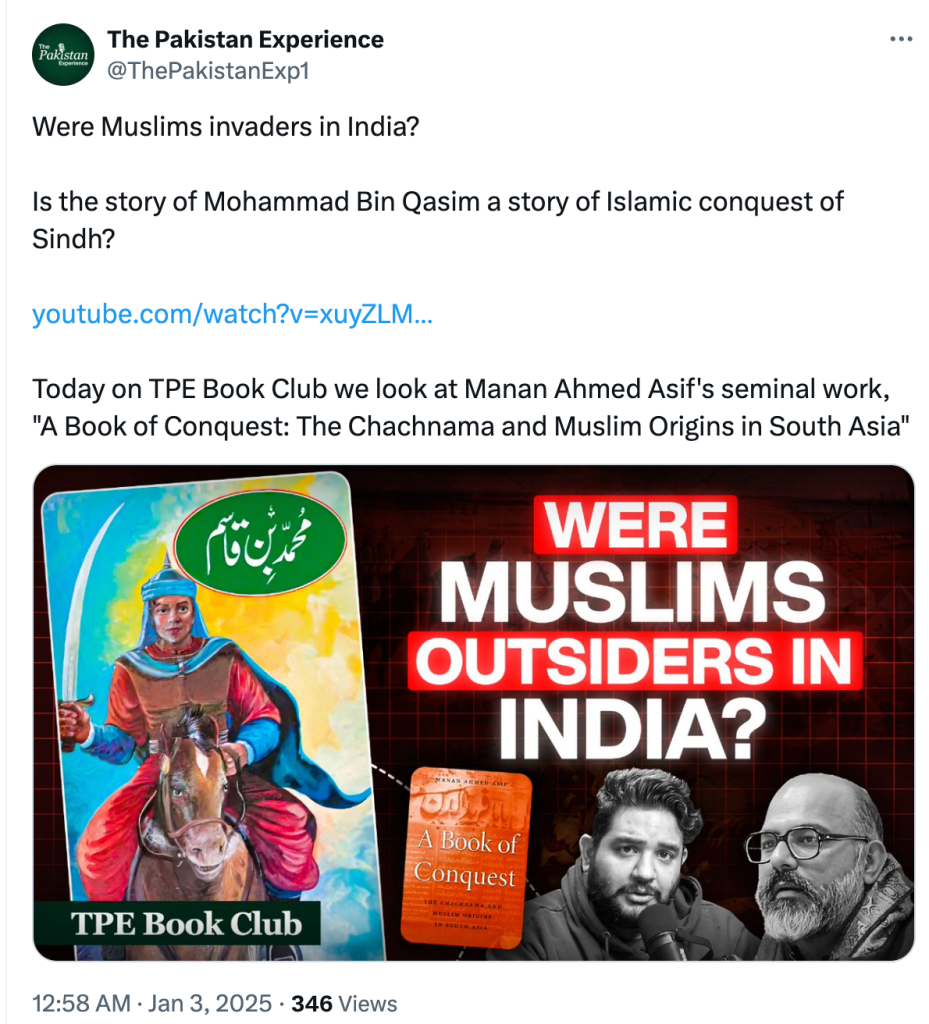
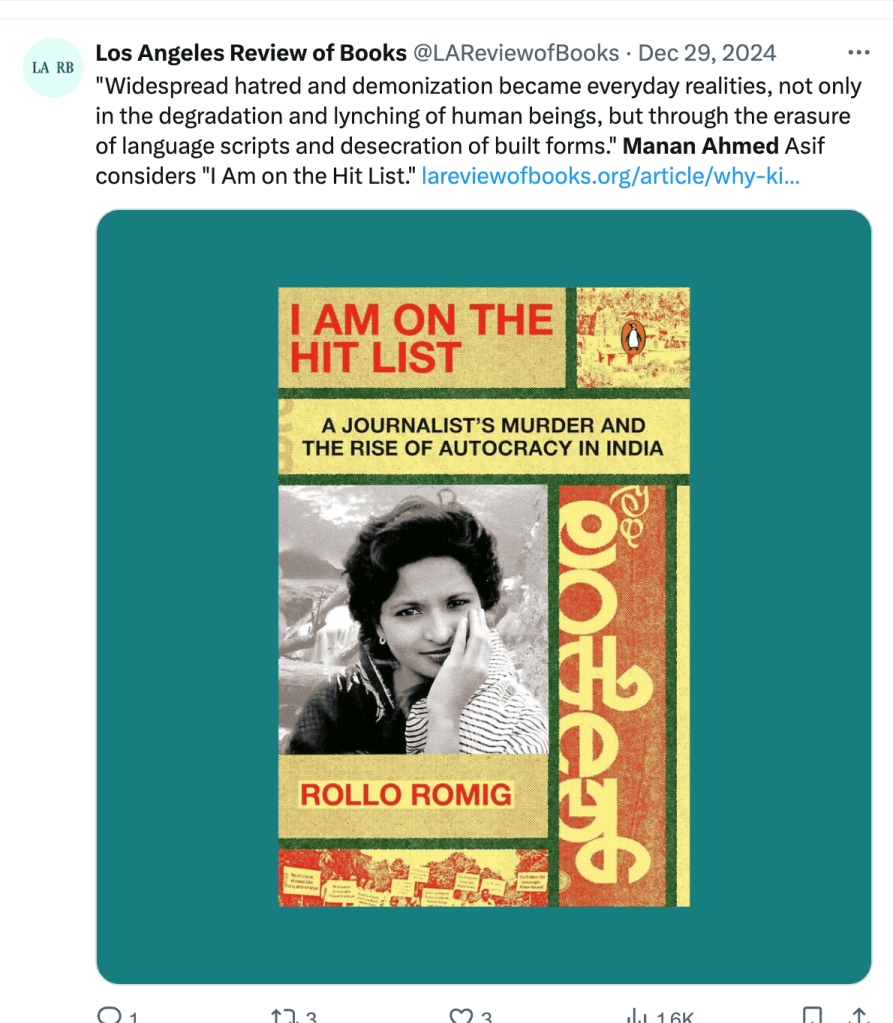
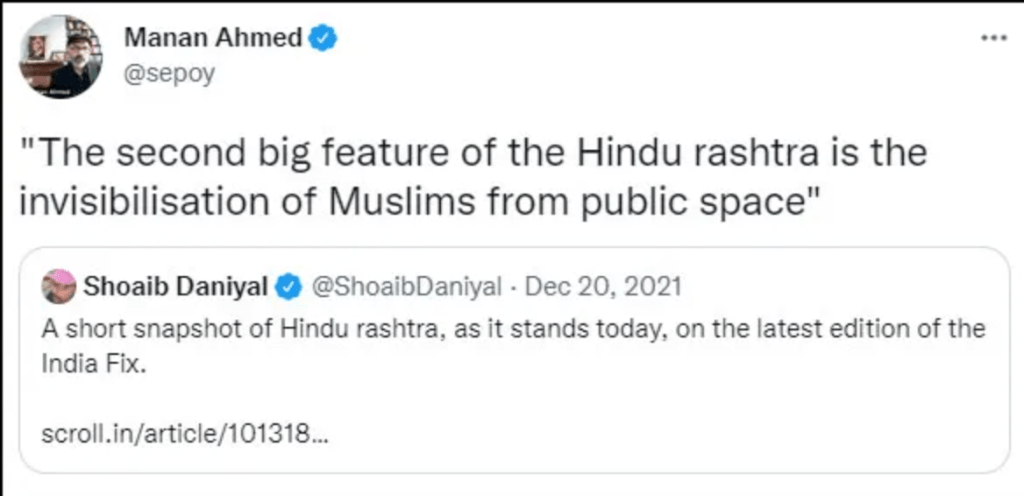
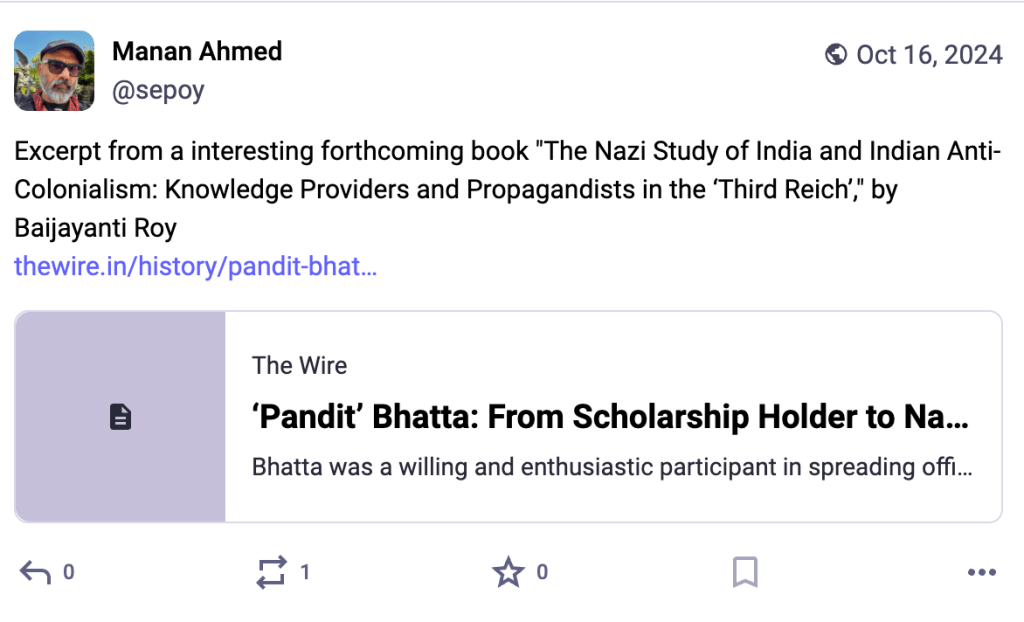
Manan Ahmed was active on social media but has since left X. He used to tweet under the handle @sepoy. Now, he can be found using the same name in Mastodon. Below are some of his social media posts.









 STOP HINDU HATE ADVOCACY NETWORK