
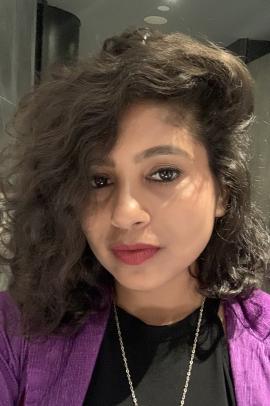
Dr Misria Shaik Ali is a Post-doctoral fellow at the Indian Institute of Technology, Delhi, in the Department of Humanities and Social Sciences. She obtained her PhD from the Department of Science and Technology Studies, Rensselaer Polytechnic Institute, New York, titled “Becoming Irradiated: The Epistemic Politics of Neglect along India’s Nuclear Fuel Cycle “. She regularly contributes to Maktoob Media, Outlook, The Wire and Two Circles, amongst others. Misria Shaik Ali is currently a committee member of the War and Genocide Working Group of the Society for the Social Studies of Science (4S) and the South Asia coordinator for the STS-IN network. Despite living in India amongst Hindus, Misria Shaik Ali, carries deep hatred for Hindus and Hinduism. Her articles focuses more on Muslim victimhood than science and technology.
Writing an article during Covid, “The spectre of Indian Muslims in India’s Covid experience“, Misria Shiaik Ali blames Hindus for Allahabad High Court’s judgement for banning loudspeakers for Azan – an Islamic prayer call during the month of Ramzan. Misria Shaik Ali says Hindus and RSS’s (Rashtraswayam Sevak Sangh) need for 50,000 daily Shakhas and political campaigns is because of the deep insecurity of “the monotheistic allure of Abrahamic religions…. which regarded the creation of a Hindu Nation as something to strive for”. She blames Hindutva for framing Islam and Muslims belonging to the past for the making of a Hindu Rashtra. In making this argument, she completely ignores the community’s resistance to modernisation instead Islamic organisations like Jamat-e-Islami aspires to make Muslims in India live a life like those how Prophet Mohammed lived 1400 yrs ago. Through out the article she rants how Hindus and the judiciary and the government have denied the Muslims their 1400 right to call for azan and how this ban on loudspeakers is anti-science, anti-modern and marginalisation of Muslims. Misria Shaik Ali further writes that Hindus are trying to establish their hegemony in New India that “needs the ‘Indian Muslim’ as an invisible presence that can continue to haunt the imaginary of partitioned India so a New India, along the lines of Hindutva, can be established. ” Towards the end, she says that to establish a Hindu Rashtra involved, “the spectacle of the Partition and the state-induced genocide that accompanied it, India-Pakistan matches, mob lynchings, sermons at Shakhas and capital punishment for terrorists like Ajmal Kasab.”
In 2024, Misria Shaik Ali wrote, “Why We Should Fear A Hindu Rashtra: A Counter-Argument” as a counter-argument for C.K. Saji Narayanan’s article, “Why fear a Hindu Rashtra?” in which she criticises Hinduism, Hindu culture, and Hindutva as Islamophobic, advancing Hindu cultural dominance, aggressive and exclusionary. She says Hindutva doesn’t expect co-existence from diverse religions on equal footing but seeks dominance of Hindu culture, a new caste system with Hindus as the new upper-caste. She questions whether Indian culture is synonymous with Hindu culture, and doing so reinforces the stereotyping of Indian identity as Hindu. She further says, “The distrust of Islam resonates with the Western idea of Islamic terrorism and is further propagated among the Indian population by the RSS, using the narratives of national security and terrorism. These narratives form the basis of fear of Muslims in the public, political, religious and social sectors. “
In her 2022 article for Two Circles, “Muslims in/of India: surrogate oppressors or colonizers?“, Misria Shaik Ali complains that right-wing and left-liberal in India consider Muslims as merely “accepted” others, or as historical colonisers and present-day oppressors, rather than as people inherently in/of India. She writes, ” The imagination of India as a land ‘indigenous’ or the birthplace of Hinduism, Buddhism, and Jainism is shared by liberal saviours, the right-wing, the communists and many, many followers of these religions.” She then goes on to question if Hinduism is indigenous to India and critiques Indic vs Abrahamic dualisms that implicitly mark Muslims and Christians as alien. Criticising India’s Ministry of Culture which has committed to creating a DNA database of Indian tribal population, Misria Shaik Ali says, “If these mythical narratives are rationalized through (politically driven) scientific research in the climate of the CAA-NRC (Citizenship Amendment Act-National Register of Citizenship) and the absence of documents, would Muslims be mandated to give up their genes to acquire citizenship?” She ends by saying that the Citizenship Amendment Act of 2019 ensures Hindus, Sikhs, Buddhists or Jains are ensured citizenship on the basis that they “originated” in India and what India might look like if the majority focused less on such myth-making and more on the concrete, critical realities of all people living in and of India.
Misria Shaik Ali, in her piece, “Anarkali ki neeche kya hain? Experiencing Hindu rashtra“, says there is pervasive anti-Muslim violence in India under the framework of “Hindu rashtra” (Hindu nation) in search for the hidden truth and that they are the victims of Hindu rashtra. To prove her point, she questions the report of Archeology Survey of India on the Ram Janamabhoomi case, questions the courts for permitting “videography and technological tools to dig deeper and look inside” the Gyanvapi disputed structure, calls the ancient Shivling as “fountain” and makes fun of Shri Ganesh murti as “ulta Ganesh” imprisoned in Qutub Minar which was built after destroying 27 Hindu and Jain temples. She opines that the courts, in their zeal for technology and hidden truth, are ignoring the sufferings of Muslims. She writes, “Looking for the hidden truth–what’s behind–has become the favourite past-time of India’s Right, hindutwadis and the majority who are in the process of discovering the hidden “Hindu rashtra”’ behind or in the past of “secular” India …” She says Hindus demonisation of Mughal history is “detrimental to understanding the structure of violence unfolding in the 2022 temple-mosque debate”. She further writes unlike in the past where stalwarts and propagandists of Hindutva orchestrated violence against Muslims, nowadays common “Hindutwadi is……empowered #tostartamandir-masjid controversy in their locality like how Hindutwadis were empowered to lynch beef eaters and cow smugglers by weakening institutions and providing impunity to perpetrators of anti-Muslim violence.” In conclusion she writes, “In searching for the hidden truth, we forget that Hindu rashtra has never been or will never be the ultimate destination for independent India.”
Again, in an article for Islamist news portal, Maktoob Media, “A loophole in BNS, enough to bury the lynched Muslim bodies“, Misria Shaik Ali, criticises India’s new criminal law, The Bharatiya Nyaya Sanhita (BNS) that replaced colonial era Indian Penal Code, as anti-Muslim for deliberately containing a loophole on mob lynching (Section 103(2)) that undermines protection for religious minorities, especially Muslims. She says the loophole omits “religion” as an explicit ground for lynchings, framing them instead as matters of “personal belief” or vague “other grounds.” She writes, the commission ” is not a mere negligence but an orchestrated governmental neglect in step with the reluctance by the Hindu majority to admit that violence is being carried out in the name of their religious belief.” She also criticises India’s anti-cow slaughter law as majoritarian, made not out of a desire to save cows but to otherise Muslims. In 2024, writing on the Waqf bill, Misria Shaik Ali says, “Amendments and acts have become tools of oppression and are cloaked by the saviorism of a Hindutva state. ” She writes about how the BJP at the centre and in some states have enacted several laws to curb child marriage, triple talaq, 2024 Wafq Amendment, etc, which are Islamophobic and Hindutva majoritarianism. She equates the Registration of Waqf properties with 1938 Nazi Germany, which required Jews to register their properties and ends by saying that resisting this bill is Islamic spirituality.
In her article, “What the Ayodhya judgment makes evident: New India is a place of ‘no Muslim things’“, Misria Shaik Ali, writing on Hindu Rashtra, says, “Evil in New India masquerades using the labels of goodness — justice, pro-national, anti-corruption, democracy, unity, pro-minority.” She further writes, “The Babri Masjid, which has lost the battle against the conquer-style politics of the BJP, once materialised the plurality of independent India in myriad celebratory and fraught ways. ” In her piece, “Being Muslim in New India is an inherently existential struggle, subsumed as community is under an emergent Hindu nation” Misria Shaik Ali laments that the 2019 victory of the BJP at the national elections had brought is “the “Hinduisation” of society” and a New India, a Hindu Rashtra, which she loathes because Hindus are getting a land of their own completely whitewashing history of India’s partition to create an Islamic state of Pakistan and then Bangaldesh. Furthermore she says Hindus fear Muslims because Muslims have something that Hindus don’t – Abraham as its father. She further goes on to lie that” India was first disintegrated with the assassination of Mahatma Gandhi” again, whitewashing the role of Sir Syed Ahmed Khan who was the first to give a call for the two-nation theory in 1888, the Muslim League’s politics of an Islamic state, the Khilafat Movement, the Direct Action Day violence of 1946 that saw 20 lakh (2 million) Hindu killed, and the overwhelming vote by Muslims for creation of Pakistan in the provincial elections in 1946. In conclusion, she says, “The modernistic Hinduism is indeed a threat to Indian Muslims in New India. ” While in, “Pulwama attack aftermath: Othering, civilising processes and life as an Indian Muslim today“, Misria Shaik Ali equates Hindu human groups to proscribed terrorist organisation, Jaish-e-Mohammed: “In this turmoil, one need only look as far as Jaish-e-Mohammed and the Hindu right-wing fringe groups in India as frogs in the same pond, magnified by their objective, operating on the grounds of religious fundamentalism. ” She writes that hate for Muslims stems from Islamophobia and colonialism, that Muslims are lured to fundamentalism because of external factors like pressure from Hindusism, local politics, etc and that any attempt to modernise Hinduism by making it more aggressive and unified is killing the diverse and tolerant “civilisation” that India used to be.
Misria Shaik Ali’s social Media presence:
X handle- @SAmisria ( Account no longer exists)
Instagram – @misriaali ( Account set to private)
 STOP HINDU HATE ADVOCACY NETWORK